Where is Uganda located in Africa? Map, Geographic Facts & Coordinates
Uganda is a landlocked country located in East Africa, positioned directly on the Equator between 1°S and 4°N latitude. The country shares borders with five nations: Kenya to the east, Tanzania to the south, Rwanda to the southwest, Democratic Republic of Congo to the west, and South Sudan to the north. Uganda’s geographic coordinates are 1.3733°N, 32.2903°E, placing it in the heart of the African Great Lakes region. Known as the “Pearl of Africa,” Uganda encompasses 241,038 square kilometers and includes a significant portion of Lake Victoria, Africa’s largest lake.
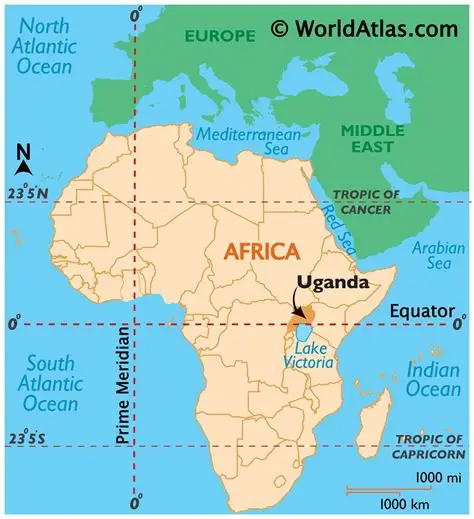
Quick Facts about Uganda’s Geographic Location
| Geographic Detail | Information |
|---|---|
| Continent | Africa |
| Region | East-Central Africa |
| Sub-region | African Great Lakes |
| Coordinates | 1.3733°N, 32.2903°E |
| Latitude Range | 1°S to 4°N |
| Longitude Range | 30°E to 35°E |
| Total Area | 241,038 sq km (93,065 sq mi) |
| Landlocked | Yes |
| Neighboring Countries | 5 (Kenya, Tanzania, Rwanda, DRC, South Sudan) |
| Capital City | Kampala (south-central region) |
| Unique Feature | Equator passes through southern Uganda |
| Average Elevation | 1,100m (3,609 ft) above sea level |
| Nickname | Pearl of Africa |
Where is Uganda on the African Map?
Uganda is situated in the eastern region of Africa, specifically in the East-Central part of the continent. On a map of Africa, you’ll find Uganda positioned within the African Great Lakes region, which is known for its numerous large freshwater lakes and rich biodiversity.
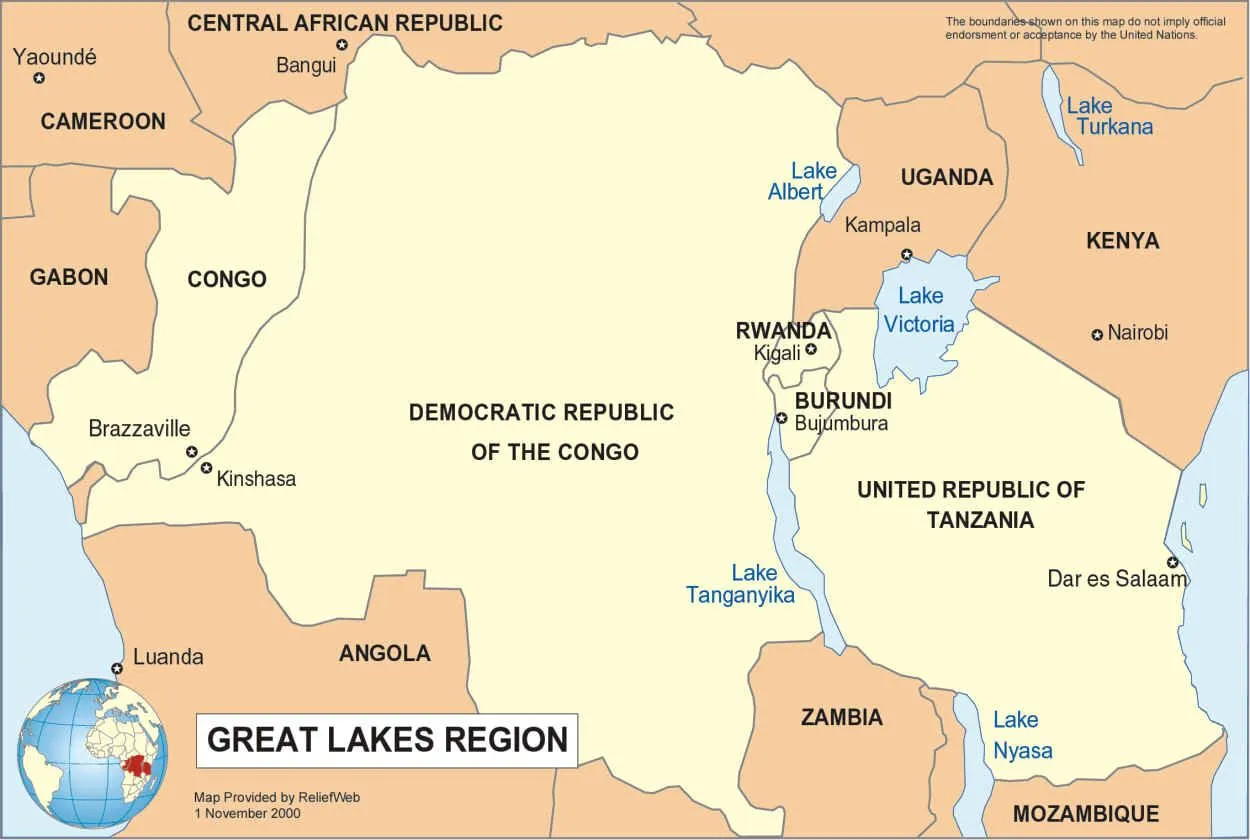
Uganda’s Position on the Map:
- Vertically: Straddling the Equator in the eastern hemisphere, between approximately 4°N and 1°S
- Horizontally: Between the 30°E and 35°E longitude lines
- Regionally: Within the East African plateau, part of the Great Rift Valley system
The country lies approximately 800 kilometers (497 miles) from the Indian Ocean to the east and about 2,000 kilometers (1,243 miles) from the Atlantic Ocean to the west, making it a landlocked nation without direct access to either coastline. Uganda’s central location in East Africa has historically made it a crucial crossroads for trade, migration, and cultural exchange across the continent.
Which Countries Border Uganda?
Uganda shares international borders with five neighboring countries, making it one of the most connected nations in East Africa. These borders stretch across diverse landscapes, from mountains and valleys to lake shores and savannas.
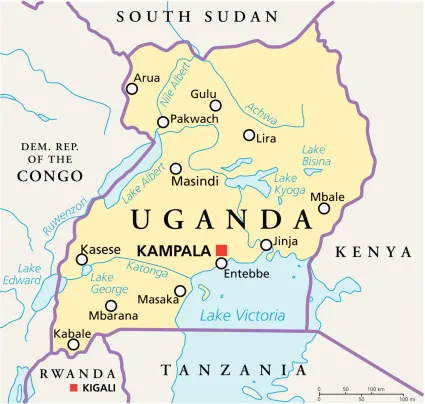
Uganda’s Five Neighboring Countries:
-
Kenya (East) - 772 km border The eastern border with Kenya runs from Lake Victoria in the south to the slopes of Mount Elgon in the north. Major border towns include Busia and Malaba, which serve as crucial trade gateways. Kenya provides Uganda with access to the Indian Ocean through the port of Mombasa.
-
Tanzania (South) - 391 km border Uganda’s southern border with Tanzania includes both land boundaries and a water border across Lake Victoria. The town of Mutukula serves as the main land border crossing, while numerous ferry services operate across Lake Victoria. Tanzania also provides sea access via the port of Dar es Salaam.
-
Rwanda (Southwest) - 172 km border The shortest of Uganda’s borders runs through the mountainous southwestern region. Key crossing points include Katuna and Cyanika, connecting Uganda to Rwanda’s capital, Kigali. This border region is known for its mountain gorilla populations.
-
Democratic Republic of Congo / DRC (West) - 877 km border Uganda’s longest border stretches along its western frontier with the DRC, running through the Rwenzori Mountains (Mountains of the Moon) in the south to the Albert Nile region in the north. This border passes through diverse ecosystems including rainforests and volcanic highlands.
-
South Sudan (North) - 475 km border The northern border with South Sudan extends across relatively flat savanna terrain. Major crossing points include Nimule and Elegu, which facilitate trade between the two nations.
Total Land Border Length: Approximately 2,687 kilometers (1,670 miles)
Together with Kenya, Tanzania, and Rwanda, Uganda forms the core of the East African Community (EAC), a regional intergovernmental organization whose formation was aimed at promoting economic and political integration. While Uganda has no ocean coastline, its southern border includes a significant portion of Lake Victoria’s northern shore, providing water access and supporting a thriving fishing industry.
Is Uganda in East, West, or South Africa?
Uganda is located in East-Central Africa, specifically in the eastern region of the African continent. It is NOT in West Africa or South Africa (the country).
Clarifying Common Geographic Confusion about Uganda’s Location
- East Africa: Uganda is part of this region.
- West Africa: Countries like Nigeria, Ghana are part of this region (Uganda is NOT located here)
- South Africa: This is a specific country at Africa’s southern tip (Uganda is NOT this country)
- Southern Africa: A region in Africa including South Africa, Zimbabwe, Botswana (Uganda is NOT in this region)
Regional Classifications for Uganda:
Uganda falls under several geographic and political classifications:
- East African Community (EAC): Political and economic organisation including Kenya, Tanzania, Rwanda, Burundi, South Sudan, and DRC
- African Great Lakes Region: Geographic area surrounding Africa’s largest lakes
- East-Central Africa: The specific sub-region between East and Central Africa
- Equatorial Africa: Countries crossed by or near the Equator
- Sub-Saharan Africa: All African countries south of the Sahara Desert
Understanding Uganda as a Landlocked Country
Uganda is a landlocked country, meaning it has no direct access to ocean coastlines. This geographic characteristic significantly influences the country’s trade, economy, and logistics.
How Uganda Accesses International Waters:
Primary Sea Ports Used by Uganda:
-
Port of Mombasa, Kenya (Eastern Route) Located on the Indian Ocean coast, Mombasa handles the majority of Uganda’s overseas cargo. Goods travel approximately 1,200 kilometers from Mombasa through Kenya, entering Uganda via the border towns of Busia and Malaba.
-
Port of Dar es Salaam, Tanzania (Southern Route) Tanzania’s major seaport serves as an alternative gateway for Ugandan trade. Goods can be transported overland through Mutukula or by ferry across Lake Victoria.
Transportation Corridors:
Northern Corridor: Mombasa → Nairobi → Kampala (the most heavily used route) Central Corridor: Dar es Salaam → Isaka → Kampala (alternative southern route) Lake Victoria Transport: Ferry services connect Ugandan, Kenyan, and Tanzanian ports
Despite being landlocked, Uganda’s strategic location at the heart of East Africa positions it as a key transit hub for goods heading to South Sudan, eastern DRC, and Rwanda.
Uganda and the Equator: Center of the Earth
Uganda is one of only 13 countries in the world crossed by the Equator, the imaginary line that divides the globe into the Northern and Southern hemispheres. This unique geographic feature makes Uganda literally the “center of the Earth” and provides several distinctive characteristics.
The Equator in Uganda:
Location: The Equator crosses Uganda in the southern part of the country, passing through several districts including Mpigi, Masaka, and Rakai.
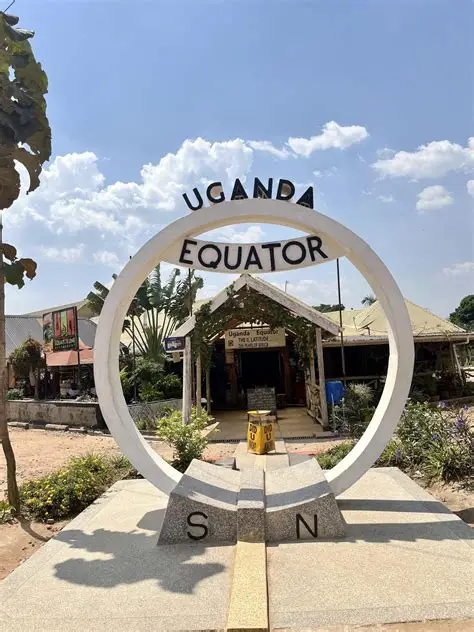
Famous Equator Monument: The most visited Equator landmark is located in Kayabwe, approximately 72 kilometers southwest of Kampala along the Masaka Road. This site has become a major tourist attraction where visitors can:
- Stand with one foot in each hemisphere
- Take photographs at the iconic Equator monument
- Observe the Coriolis effect demonstration with water drainage
- Purchase locally-made crafts and souvenirs
- Experience cultural performances from local communities
- Sample traditional Ugandan cuisine
Effects of Equatorial Location:
- Climate: Uganda experiences a warm tropical climate year-round with minimal temperature variation
- Daylight Hours: Nearly equal day and night lengths throughout the year (approximately 12 hours each)
- Seasons: Two rainy and two dry seasons rather than summer/winter distinctions
- Sun Position: The sun passes directly overhead twice a year at the Equator
Uganda’s Administrative Geography: Districts and Regions
Uganda is divided into 135 districts grouped into four administrative regions, each with distinct geographic and cultural characteristics. Understanding Uganda’s internal geography helps locate specific areas within the country.
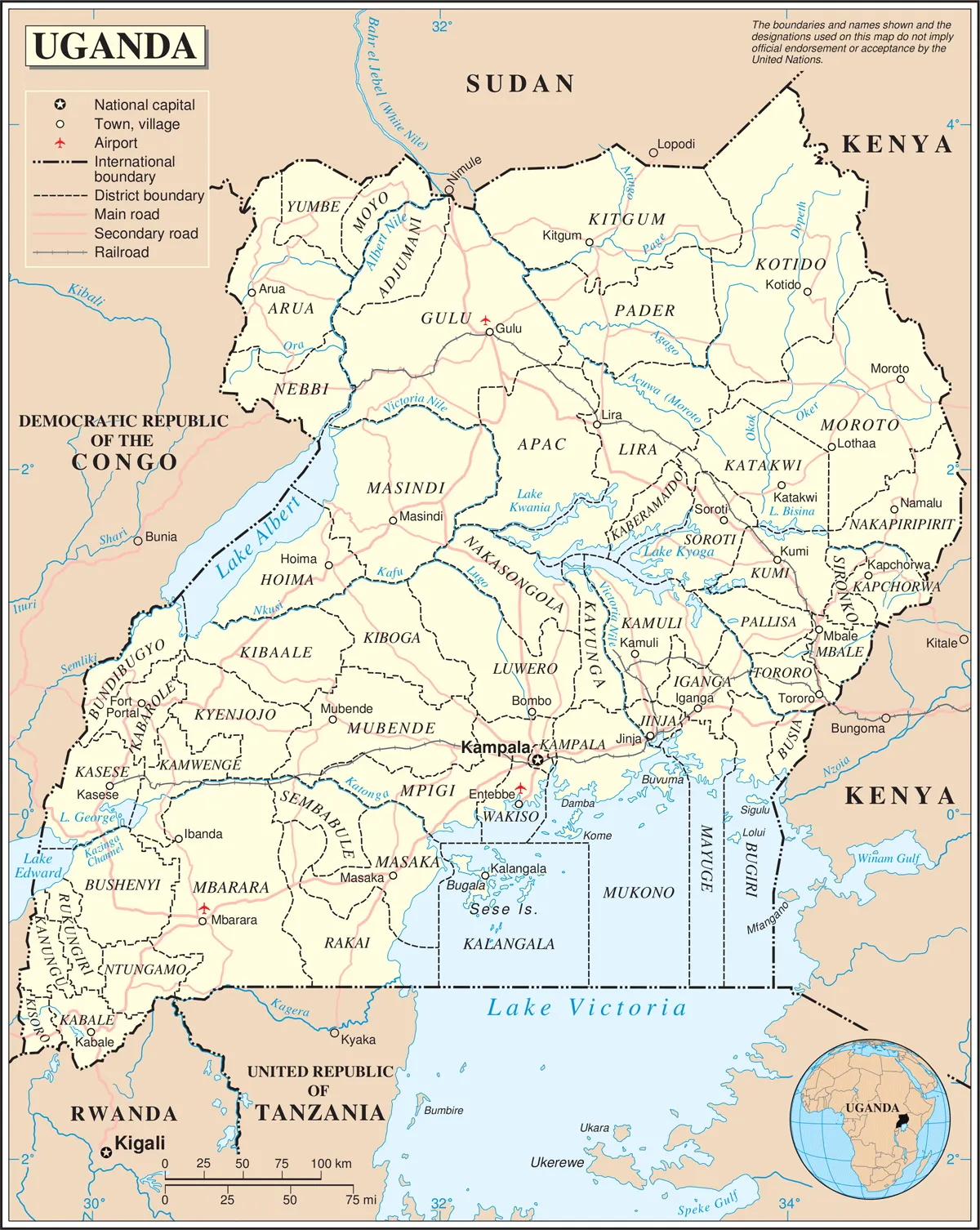
The Four Regions of Uganda:
-
Central Region Home to the capital Kampala and surrounding districts. This is Uganda’s most urbanized and economically developed region. Key districts include Kampala, Wakiso, Mukono, and Mpigi.
-
Eastern Region Bordered by Kenya, this region includes Mount Elgon and the source of the Nile in Jinja. Major districts include Mbale, Jinja, Soroti, and Tororo.
-
Northern Region Bordering South Sudan, this region features savanna landscapes and is home to Kidepo Valley National Park. Key districts include Gulu, Lira, Kitgum, and Arua.
-
Western Region The most mountainous region of Uganda, featuring the Rwenzori Mountains, numerous national parks, and borders with DRC and Rwanda. Major districts include Mbarara, Fort Portal, Kasese, and Kabale.
Interesting Geographic Distribution:
- Total Districts: 135 (as of 2024)
- Capital City: Kampala (independent administrative unit)
- Most Districts: Western Region
- Largest District by Area: Karamoja sub-region districts
- Most Populated: Kampala and Wakiso districts
Uganda’s Geographic Coordinates and Map Details
For tourists, geographers, and navigation purposes, understanding Uganda’s precise coordinates is essential.
Geographic Coordinates:
- Central Point Coordinates: 1.3733°N, 32.2903°E (This represents the approximate geographic center of Uganda)
- Latitude Range: 4°14’N (northernmost point) to 1°29’S (southernmost point)
- Longitude Range: 29°34’E (westernmost point) to 35°00’E (easternmost point)
Extreme Points of Uganda:
- Northernmost Point: Near Nimule, border with South Sudan (Adjumani District)
- Southernmost Point: Near Kikagati, border with Tanzania (Isingiro District)
- Easternmost Point: Near Mount Elgon, border with Kenya (Kapchorwa District)
- Westernmost Point: In the Rwenzori Mountains, border with DRC (Kasese District)
Distance Measurements:
- North to South: Approximately 650 kilometers (404 miles)
- East to West: Approximately 500 kilometers (311 miles)
- Coastline: 0 km (landlocked)
- Lake/Water Border: Approximately 200 km along Lake Victoria and Lake Albert
Time Zone:
East Africa Time (EAT): UTC+3 Uganda operates on East Africa Time year-round with no daylight saving time adjustments.
The Flag and Ethnic Diversity Map of Uganda
Uganda’s national identity is reflected in both its national flag and the rich ethnic diversity spread across its geographic regions.
Uganda’s National Flag:
The Ugandan flag consists of six horizontal stripes of black, yellow, and red (repeated twice) with a white circle in the center containing a grey crowned crane, the national bird.
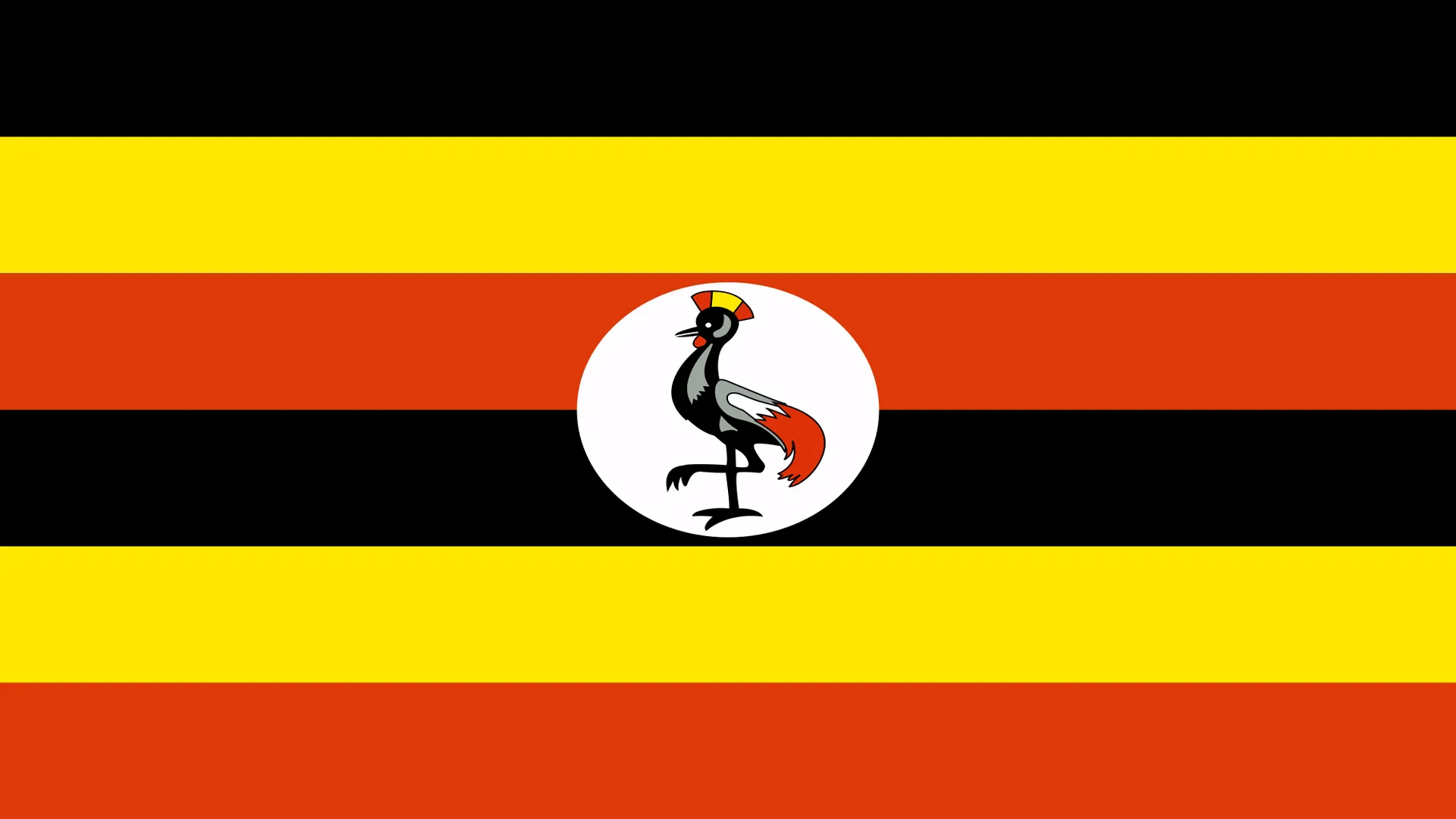
Ugandan Flag Symbolism:
- Black: Represents the African people
- Yellow: Symbolizes Africa’s sunshine and abundant natural resources
- Red: Represents African brotherhood (all people share the same blood)
- Grey Crowned Crane: Symbolizes Uganda’s forward movement and rich wildlife
Ethnic and Cultural Geography of Uganda:
Uganda is home to over 50 ethnic groups distributed across different geographic regions. The country’s ethnic diversity reflects its position as a historic crossroads between Bantu, Nilotic, and Sudanic peoples.
Major Ethnic Groups by Region:
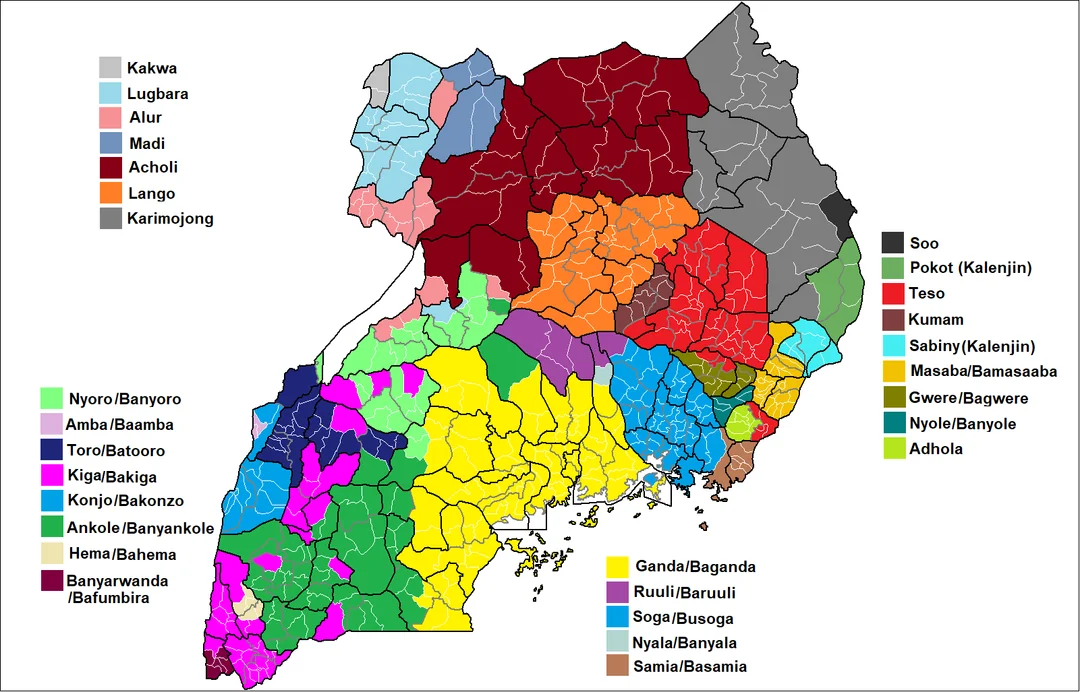
- Central Region: Predominantly Bantu groups including Baganda (largest ethnic group), Banyoro, Batoro
- Eastern Region: Bantu and Nilotic groups including Basoga, Bagisu, Iteso, Karamojong
- Northern Region: Primarily Nilotic and Sudanic groups including Acholi, Langi, Lugbara
- Western Region: Bantu groups including Banyankole, Bakiga, Batooro, Banyoro
How to Reach Uganda: Transportation Access
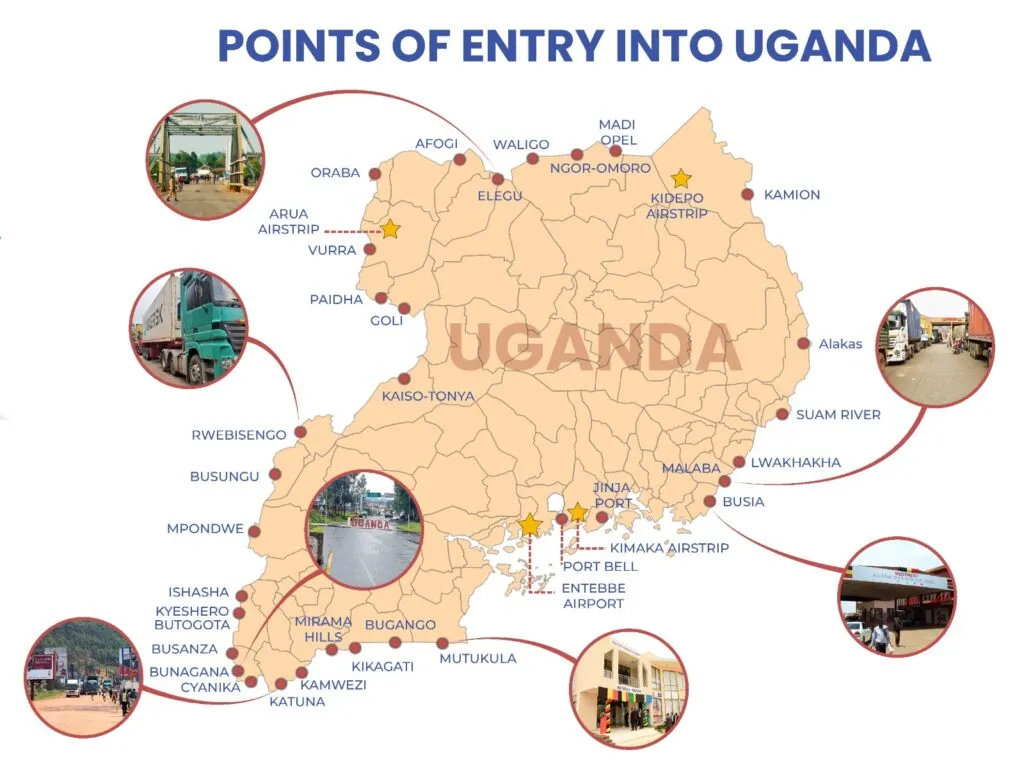
As a landlocked country in East-Central Africa, Uganda is primarily accessed by air, with some visitors entering overland from neighboring countries.
By Air:
Entebbe International Airport (EBB) Uganda’s only international airport is located in Entebbe, approximately 40 kilometers (25 miles) southwest of Kampala on the shores of Lake Victoria.
Major Airlines Serving Uganda:
- European Carriers: KLM, Brussels Airlines, Turkish Airlines, British Airways, Qatar Airways, Ethiopian Airlines
- Middle Eastern Carriers: Emirates, Qatar Airways, Etihad Airways
- African Carriers: Kenya Airways, RwandAir, South African Airways
- National Carrier: Uganda Airlines (resumed operations in 2019)
Major Routes:
- Europe: Amsterdam, Brussels, London, Istanbul
- Middle East: Dubai, Doha, Abu Dhabi
- Africa: Nairobi, Addis Ababa, Kigali, Johannesburg, Dar es Salaam
Flight Times to Entebbe:
- From Europe: 8-10 hours (direct flights)
- From Middle East: 5-6 hours
- From Nairobi: 1.5 hours
- From Kigali: 1 hour
From Airport to Kampala:
- Private Shuttle: Pre-booked services (recommended)
- Taxi: Available at airport, negotiate price in advance
- Car Rental: Several agencies operate at the airport
- Hotel Transfers: Most hotels offer pickup services
- Journey Time: 45-90 minutes depending on traffic
Overland Access:
From Kenya:
Border crossings at Busia and Malaba (most common), Suam, and Lwakhakha
From Tanzania:
Border crossing at Mutukula; ferry services across Lake Victoria
From Rwanda:
Border crossings at Katuna (Kabale) and Cyanika (Kisoro) - approximately 4 hours from Kigali
From DRC:
Border crossings at Mpondwe-Kasindi and Bunagana (security situation dependent)
From South Sudan:
Border crossing at Nimule (security conditions apply)
Frequently Asked Questions About Uganda’s Location
Where is Uganda located?
Uganda is located in East-Central Africa, bordered by Kenya to the east, Tanzania to the south, Rwanda to the southwest, Democratic Republic of Congo to the west, and South Sudan to the north. It sits in the African Great Lakes region, straddling the Equator.
What part of Africa is Uganda in?
Uganda is in the East-Central region of Africa, specifically within the African Great Lakes area. It is NOT in West Africa, South Africa (the country), or Southern Africa (the region).
Is Uganda in East Africa or West Africa?
Uganda is in East Africa (specifically East-Central Africa). It is a founding member of the East African Community along with Kenya, Tanzania, Rwanda, and Burundi. West Africa is on the opposite side of the African continent, thousands of kilometers away.
How big is Uganda?
Uganda covers 241,038 square kilometers (93,065 square miles), making it roughly the size of Great Britain or the U.S. state of Oregon. It ranks as the 81st largest country in the world by land area.
What region is Uganda in?
Uganda belongs to several overlapping geographic regions: East-Central Africa (primary), the African Great Lakes region (geographic), the East African Community (political/economic), and Equatorial Africa (climatic).
Is Uganda landlocked?
Yes, Uganda is a landlocked country with no direct access to ocean coastlines. It relies on ports in Kenya (Mombasa) and Tanzania (Dar es Salaam) for overseas trade. The nearest ocean is the Indian Ocean, approximately 800 kilometers to the east.
Where is Uganda located on the world map?
On a world map, Uganda is located in East-Central Africa, in the Eastern Hemisphere. Its coordinates are 1.3733°N, 32.2903°E, positioning it directly on the Equator between 1°S and 4°N latitude.
What countries are near Uganda? Uganda shares borders with five countries: Kenya (east), Tanzania (south), Rwanda (southwest), Democratic Republic of Congo (west), and South Sudan (north). It is also near Burundi, which lies just south of Rwanda.
Where is Uganda located in Africa map
On a map of Africa, Uganda is positioned in the east-central region of the continent, within the African Great Lakes area. It’s located west of Kenya, north of Tanzania and Rwanda, east of the Democratic Republic of Congo, and south of South Sudan.
What is Uganda famous for?
Uganda is famous for its diverse wildlife including mountain gorillas (half the world’s population), being the source of the Nile River, its position on the Equator, Lake Victoria, the Rwenzori Mountains, and numerous national parks. It earned the nickname “Pearl of Africa” for its stunning natural beauty.
What is the nickname of Uganda?
Uganda’s nickname is the “Pearl of Africa,” a name given by British explorer Sir Winston Churchill in his 1908 book “My African Journey,” owing to Uganda’s magnificent scenery, diverse wildlife, and favorable climate.
What city is famously called the tourist city of Uganda?
Fort Portal, located in western Uganda, is famously known as the “Tourism City of Uganda” due to its proximity to numerous national parks, crater lakes, hot springs, and the Rwenzori Mountains.
What was Uganda called before independence?
Before gaining independence in 1962, Uganda was called the “Uganda Protectorate” under British colonial rule from 1894 to 1962.
What currency is used in Uganda?
The Ugandan Shilling (UGX) is the official currency of Uganda. The smallest denomination is the 1,000 shilling note (coins are rarely used), while the largest is the 50,000 shilling note. As of 2024, exchange rates fluctuate around 3,700-3,900 UGX per 1 USD.
Is Uganda safe for tourists?
Uganda is generally safe for tourists, with millions visiting annually for gorilla trekking and safaris. Standard travel precautions apply: use registered tour operators, avoid isolated areas at night, and follow current travel advisories. Border regions may have specific security considerations.
What language is spoken in Uganda?
English is the official language of Uganda, used in government, education, and business. Swahili is also an official language. However, Uganda has over 40 indigenous languages, with Luganda being the most widely spoken local language, especially in the central region.
What is the capital of Uganda?
Kampala is the capital and largest city of Uganda, located in the south-central region of the country on the northern shores of Lake Victoria. The city serves as Uganda’s political, economic, and cultural hub with a population exceeding 1.5 million people.
What is the capital city of Uganda?
Kampala is the capital city of Uganda
Is Uganda located in Central Africa?
No. Uganda is located in East Africa neigbouring Kenya to the east, Sudan to the north, Tanzania to the south, Rwanda to the south east and the Democratic Republic of Congo to the west.
What region of Africa is Uganda located in?
Uganda is located in the Eastern Region of Africa.
Conclusion: Uganda’s Strategic Location in Africa
Uganda’s position in East-Central Africa, at the heart of the African Great Lakes region, places it at a geographic and cultural crossroads of the continent. Straddling the Equator and surrounded by five diverse neighbors, Uganda benefits from its central location despite being landlocked.
For more essential travel information, check out our other travel guides:
- Everything You Need to Know When Applying for the Ugandan Travel Visa
- Where is Uganda Located in Africa
- What Currency is used in Uganda
- History, Design and Meaning behind the Uganda Flag
- History, Design and Symbolism behind the Uganda Coat of Arms
- A Guide to the Composition and Structure of the Uganda Nationa Anthem
- Complete Guide to Ugandan Time, Timezone and comparison with major cities around the world
Planning Your Trip to Uganda?
Now that you understand all there is to know about the most popular language of Uganda, the Luganda, you’re better suited for a visit to Uganda. Browse our itineraries or contact us to start planning your adventure to Uganda.